Monday, March 21, 2022

Napoleon Bonaparte - Leader Earns Trust....


Emperor Napoleon I often made some actions which were inexplicable even from the point of view of his generals. Late at night he could slip his cloak over the shoulders, put on his famous cocked hat and without any convoy went to inspect posts.

Once during this inspection the emperor saw a sentry who was sleeping on his post. Military time regulations were very strict, but fair: the punishment for such breach was an immediate field court and shooting. A sleeping soldier on his post exposed to danger not only himself, but his companions’ lives which he was guarded. But Napoleon, as always, behaved very paradoxically. He took a heavy gun of the sleeping sentry and stood on the post. When some time later a guard commander came with changing of the guard, he saw to his surprise and horror that the sentry was peacefully sleeping under the bush and his place was occupied by the emperor.

“Stop! Who’s there?” – Napoleon asked according to regulations, taking the gun from his shoulders.

Taken aback from such view soldiers even broke formation watching the emperor on the post. The guard commander some time later collected himself and answered: “Changing of the guard! Go off duty!”

“Gone of duty!” – Napoleon reported soldierly and then said in absolutely other voice: “Don’t wake the soldier! Let him have enough sleep.”

There wasn’t any punishment for the sentry.

When Norman Copeland was writing his famous book “Psychology of direction” he repeatedly took examples from history. Particularly when he was explaining methods of group’s rallying around the leader he gave this case from Napoleon. 


Saturday, March 12, 2022

Priest's Retirement Speech

Retired Priests | Denver Parish Connect 

 Priest's Retirement Speech
 
A Priest was being honoured at his retirement dinner after 25 years in the parish.
                             
The leading local politician  was chosen to make the presentation and to give a little speech at the dinner.
 
However, he was late, so the Priest decided to say his own few words while they waited:

He commenced with: “Thank Goodness we have a wonderful sense of humour!”
 
“I got my first impression of this parish from the very first confession I ever heard here. I thought I had been assigned to a terrible place. The very first person who entered my confessional, and whom I shall not name, told me he had stolen a television set and, when questioned by the police, was able to lie his way out of it.  He had stolen money from his parents;  embezzled from his employer; taken illegal drugs; had several affairs;  was arrested several times for public nuisance.  I was appalled that one person could do so many awful things.  But as the days went on, I learned that my people were not all like that and I had, indeed, come to a fine parish full of good and loving people.”
 
Just as the Priest finished his talk, the politician arrived full of apologies at being late. He immediately began to make the presentation and gave his talk:
 
“I’ll never forget the first day our parish Priest arrived,” said the politician.  “In fact, I had the honor of being the first person to go to him for confession.”
 
 
Moral: Never, Never, Never Be Late
😂😂😂😂

Thursday, March 10, 2022

Reaching results with no efforts!?

Thomas von Kempen JS.jpg 

 John à Kempis says (as it is put in his life): ‘We like to be humble without humiliation, to be obedient without being under authority, to be poor but to lack nothing, to be virtuous without a struggle, to be loved without goodness, to be thought much of without holiness.’

Friday, March 4, 2022

Russian Jew - Joke - Statue of Lenin

Soviet era statue of Vladimir Lenin. Tallinn, Estonia ... A Russian Jew was finally allowed to emigrate to Israel.
At Moscow airport, customs found a Lenin statue in his baggage and asked, "What is this?"

The man replied, "What is this? Wrong question comrade. You should have asked : Who is he? This is Comrade Lenin. He laid the foundations of socialism and created the future and prosperity of the Russian people. I am taking it with me as a memory of our dear hero."

The Russian customs officer let him go without further inspection.

At Tel Aviv airport, the Israeli customs officer also asked our friend, "What is this?"

He replied, "What is this? Wrong question, Sir. You should be asking, 'Who is this?' This is Lenin, the fool who caused me, a Jew, to leave Russia. I take this statue with me so I can curse him every day."

The Israeli customs officer said, "I apologize, Sir, you are cleared to go"

Settling into his new house, he put the statue on a table. To celebrate his immigration, he invited his friends and relatives to dinner.

One of his friends asked, "Who is this?"
He replied, "My dear friend, 'Who is this' is a wrong question. You should have asked, What is this?
This is ten kilograms of solid gold that I managed to bring with me without paying any customs duty and tax."
 
MORAL :-
Politics is when you can tell the same thing in different ways to fool different audience,and steal their money and allow you to look good in every way.

😂😂😂

Monday, February 21, 2022

St. Peter's bones

 https://aleteia.org/2018/10/29/the-incredible-story-of-the-hunt-for-st-peters-bones/

The incredible story of the hunt for St. Peter’s bones

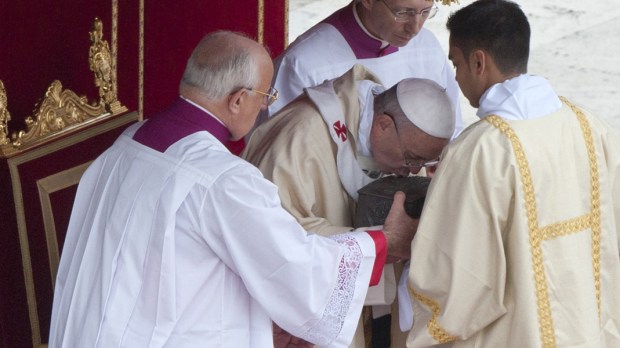
November 24, 2013 : Pope Francis kisses the relics of the Apostle Peter on the altar during a mass at St. Peter’s Square at the Vatican

Alessia Giuliani | CPP

Pope Francis kisses the relics of the Apostle Peter on the altar during a mass at St. Peter's Square at the Vatican

As workers dug their way deeper into the history of the necropolis underneath the Vatican they were, as O’Neill puts it, “traveling back in time.”

In 1941—as bombs were falling over London, German tanks were rolling into Russia, and most of continental Europe was under the Nazi flag or its allies—one of the most epic archaeological quests in history was underway in the center of the chaos.

Deep under St. Peter’s Basilica, workers had begun the search for the bones of the first pope who, according to Church tradition, had been martyred and buried there.

It all started with an accident.

In 1939, workers were excavating the floor in the grottoes beneath St. Peter’s altar in order to make room for a chapel where recently deceased Pope Pius XI had asked to be buried. Suddenly, the floor broke through, revealing an ancient Roman mortuary with striking murals of wildlife and the tomb of a young Christian woman—all hidden and unseen for more than a millennium.

When informed of the discovery, Pope Pius XII faced a choice. Church tradition holds that the first pope was martyred and buried in Rome. Proceeding with the excavation could verify that tradition, but the flip side was that failing to find the remains would be “deeply unsettling” given Rome’s status as the seat of the papacy, as author John O’Neill explains in his recent book, The Fisherman’s Tomb, which tells the story of the search for St. Peter’s tomb. Yet Pius XII took what outsiders may view as a gamble because of his “unwavering faith that Peter was there.” (The account presented here is based on O’Neill’s book.)

The excavation commenced with one big clue as to where St. Peter might be. One of the Vatican Library’s treasures, the 1,500-year-old Book of the Popes, described in detail where St. Peter’s bones rested—within a bronze sarcophagus enclosed in marble and surrounded with other treasure. A monument known as the Trophy of Gaius supposedly marked the spot.

The excavation was a massive undertaking, requiring the construction of special pillars to hold up the basilica and rest of the Vatican buildings above it—what O’Neill describes as “one of the largest and heaviest structures on earth.” Under the pope’s orders, the work was to be done in strict secrecy, so the use of power tools was prohibited. All of this depended on the financial backing provided by a Texas oilman and devout Catholic named George Strake, who contributed on the condition of anonymity.

As workers dug their way deeper into the history of the necropolis underneath the Vatican they were, as O’Neill puts it, “traveling back in time.” As the dirt was cleared away, the world of ancient Rome came alive. Two hundred years worth of pagan family tombs were uncovered, along with numerous statues and murals of the hero Hercules and the god Pluto.  

So far, the excavators had only come across one reference to Peter—a painting of Christ and Peter along with an inscription invoking the apostle’s prayers.

Then the team—led by Vatican priest and archaeologist Antonio Ferrua—had a breakthrough: they chanced upon another underground tomb, splashed in Christian images of the resurrected Christ, the Good Shepherd, and Jonah and the whale.

Encouraged by their findings, the team pressed forward. As they burrowed deeper into history they passed through one altar that had been built in the Renaissance and two others dating to the time of the crusades. They also came upon two walls—the Red Wall from the time of Marcus Aurelius in 160 and another, known as the Graffiti Wall, dating to 250. The latter would later prove crucial to their quest, but, for the time being, the excavation moved on.

Finally, in 1942, excavators found what they thought was the Trophy of Gaius. Although there was no magnificent sarcophagus or enclosure, they did find bones in a small opening in the Red Wall. The pope’s personal doctor examined the remains and declared them to be from a 65-year-old man. The world would not know of the apparent discovery until seven years later—when an Italian journalist broke the story.

But, in a way, the search for St. Peter’s bones was just beginning.

First, the Vatican had to ensure Rome was spared the devastation that leveled other European cities. The Americans held off on bombing and mounting other attacks on Rome, thanks to the diplomatic efforts of three Vatican priests—Monsignor Giovanni Montini, Walter Carroll, and Joseph McGeough. (The first was to become the future Pope Pius VI; the latter two were American-born.) The Vatican was also able to get the retreating Germans to refrain from flattening Rome as they withdrew.

Rome survived WWII and so did St. Peter’s alleged bones, until news of the discovery became public in 1949. One year later a noted Italian archaeologist, Margherita Guarducci, was invited to inspect the excavated necropolis beneath the Vatican. She found that the team had not adhered to “basic archeological procedures,” according to O’Neill. She informed Pope Pius XII, who put her in charge of the project.

Among her first tasks was deciphering the jumble of inscriptions on the Graffiti Wall that had been previously ignored. Among the letters were deeply symbolic Christian symbols like P for Peter, R for resurrection, and T for the cross. And then Guarducci found a giant clue—an inscription that read “Near Peter.” Next to it was one she had glimpsed earlier “Peter is within.”

A medical anthropologist subsequently examined the bones that initially had been assumed to be those of St. Peter and determined that the finding was false. He then verified the authenticity of the second finding. In 1965, the Vatican published a report by Guarducci disclosing the new finding.

But Ferrua—Guarducci’s predecessor—launched a disinformation campaign challenging the authenticity of Guarducci’s work. After the death of Pius VI in 1978, Guarducci lost one of her last key allies in the Vatican. From his position as rector of the Pontifical Institute for Christian Archaeology, Ferrua was able to marginalize Guarducci and remove the bones from the Graffiti Wall. As a result, the truth about St. Peter’s bones remained clouded in controversy for decades.

Finally, Pope Benedict XVI ordered a review of the matter, which was concluded under Pope Francis. The review reaffirmed Guarducci’s conclusions and, on December 5, 2013, Pope Francis had the bones restored to their former resting place.


Sunday, October 10, 2021

Block advertisements on Android phones (tamil)


à®®ிக சுலபமாக பயன்படுத்த கூடிய வழி.

வழி 1:

  1. உங்கள் ஃபோன் à®…à®®ைப்புக்கு செல்லவுà®®்
  2. à®…à®™்கே private dns என தேடவுà®®். பெà®°ுà®®்பாலான ஃபோன் à®…à®®ைப்பில் அது Settings > Network and Internet > Advanced > Private DNS இருக்குà®®்
  3. இப்போது http://dns.adguard.com
  1. டைப் செய்து Save செய்யவுà®®்.
  2. இனி விளம்பரம் வருவது 99% குà®±ைந்து விடுà®®்.

வழி 2:

  1. உங்கள் à®®ொபலை à®°ூட் (root) செய்வதன் à®®ூலம் விளம்பரங்களை தடுக்கலாà®®்.
  2. இது கொஞ்சம் à®°ிஸ்க் எடுக்க வேண்டிய வழி..நான் இதை பரிந்துà®°ை செய்வது இல்லை.
  3. à®®ேலுà®®் à®°ூட் பற்à®±ி தெà®°ிய
How to Root your Android smartphone — quick and easy-to-follow steps
Rooting an Android device or smartphone opens up a world of new possibilities. Here's how to root your phone in quick and easy steps!